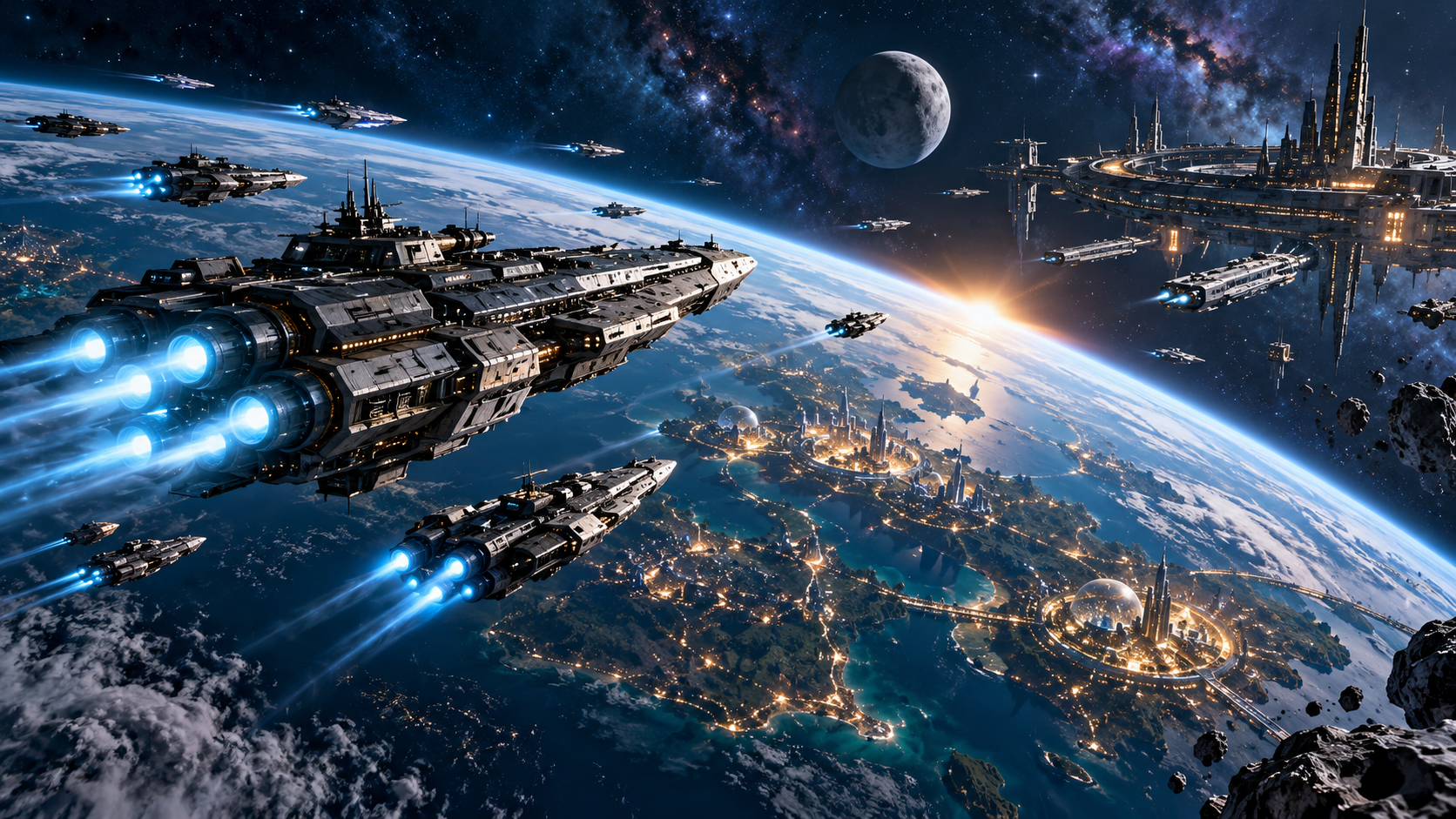
A Corrado OGame fleet approaches a glowing colony world beneath its orbital shipyard.
Current website check: 21 October 2026
The Corrado Game homepage still presents the project as a high-speed private OGame-style server and states a history beginning in 2009. It displays language choices and links for login and rules. Those observations do not verify current player numbers or the settings of every available universe.
The historical material below should be read as history. Before registering, confirm the specific universe, economy and flight speeds, continuity conditions and current rules. Corrado and Gameforge’s official OGame are separate services.
A practical pre-registration checklist
- Identify the operator and account system.
- Read production and flight speeds separately.
- Check whether older descriptions match the selected universe.
- Review support, restart conditions and any payment terms.
- Use a unique password and verify availability before committing time.
Compare other approaches in our guide to games like OGame and learn how to interpret settings in our server guide.
For fans of classic browser-based strategy games, Corrado OGame represents an interesting chapter in the history of online space warfare. Combining the familiar empire-building mechanics of OGame with accelerated progression, multiple universes and a dedicated community, Corrado Game emerged as an alternative for players who wanted to experience the excitement of galactic conquest without spending weeks waiting for their empires to develop.
But what exactly is Corrado OGame? Where did it come from, how does it differ from the original OGame, and why has it attracted attention from strategy enthusiasts for so many years?
In this article, we explore the history of Corrado Game, its most interesting features, lesser-known facts, and the gameplay strategies that helped make high-speed OGame servers popular.
What Is Corrado OGame?
Corrado OGame, also known as Corrado Game, is a browser-based multiplayer space strategy game inspired by the classic OGame experience.
Its official website, corrado-game.org, describes the project as a high-speed OGame private server with a history dating back to 2009.
Like traditional OGame, Corrado Game puts players in charge of an expanding interplanetary empire. Starting with limited infrastructure and resources, commanders must construct buildings, develop technologies, establish colonies, assemble fleets and interact with rival civilizations.
The central gameplay revolves around three essential resources:
- Metal: The foundation of most construction and shipbuilding.
- Crystal: An important material for advanced technology and spacecraft.
- Deuterium: A valuable resource used in research and fleet operations.
Successful players must balance economic development, military strength, technological research and diplomacy.
What makes Corrado Game particularly interesting is its emphasis on speed.
Instead of focusing on the relatively slow progression associated with traditional OGame universes, Corrado Game has historically promoted dramatically accelerated construction and resource production.
This creates a different strategic environment in which both new and experienced players can develop substantial empires more quickly.
The Origins of Corrado OGame
The Legacy of the Original OGame
To understand Corrado OGame, we first need to look at the game that inspired it.
OGame was originally created by German developer Alexander Rösner, also known by the nickname Legor.
The original game launched in October 2002 and became one of the most influential browser-based strategy titles of its era.
At a time when most multiplayer games required dedicated software, OGame offered something remarkably accessible: an enormous persistent universe that could be managed directly from a web browser.
Players could establish colonies, construct fleets, research technologies and compete with thousands of other commanders.
One of its greatest innovations was persistence. The universe continued functioning even when players were offline.
A fleet could travel toward an enemy planet while its owner slept. Resource mines continued producing materials, and rival alliances could organize complicated military operations across different time zones.
This persistent approach created fascinating strategic possibilities.
However, it also introduced one of OGame’s most divisive characteristics: waiting times.
As players advanced, buildings, technologies and fleet movements could require increasingly significant amounts of time.
For some, this was an essential part of the strategy. For others, it created an opportunity for faster alternatives.
The Rise of Private OGame Servers
As OGame became increasingly popular, communities began experimenting with independently operated games inspired by its mechanics.
These projects often retained recognizable elements such as planetary development, ship research, moons and fleet combat while modifying progression rates or introducing additional features.
High-speed servers were particularly appealing.
They offered players an opportunity to experiment with advanced fleets and large-scale space battles without necessarily committing to the same progression schedule as a conventional universe.
Corrado Game emerged within this broader movement.
Corrado Game’s Beginnings in 2009
According to its official website, Corrado Game has operated as a project since 2009.
This is significant because the early 2010s were an important period for independent browser-game communities.
Rather than trying to reinvent every aspect of space strategy, Corrado focused on providing a faster version of an already successful formula.
Historical references provide additional evidence of the project’s early activity.
A listing on BrowserMMORPG identifies Corrado Game as a science-fiction browser game and records its presence on the directory from September 26, 2011.
That listing also includes player reviews dated August 2012, praising the server’s responsiveness and active community.
Meanwhile, Corrado Game’s own website preserves multiple articles published in April 2013, discussing gameplay, speed, resource management and advanced tactics.
Together, these records illustrate how Corrado established an identifiable presence in the browser-based strategy community well over a decade ago.
Historical timeline
| Year | Milestone |
|---|---|
| 2002 | The original OGame launches. |
| 2009 | Corrado Game’s stated beginning. |
| 2011 | Corrado Game appears in a historical browser-game directory listing. |
| 2012 | Archived player reviews discuss server responsiveness and multiplayer activity. |
| 2013 | Corrado publishes guides and community articles explaining its gameplay. |
| 2020s | The project’s website continues presenting its history, rules and high-speed strategy concept. |
These dates are based on historical references and the project’s own statements. They do not establish uninterrupted server availability throughout every year.
What Makes Corrado OGame Different?
Although Corrado shares many familiar concepts with OGame, several characteristics have helped distinguish its identity.
1. Accelerated Resource Production
Resource production is fundamental to every successful space empire.
In conventional OGame, players gradually upgrade mines to generate the materials required for increasingly expensive structures and spacecraft.
High-speed Corrado universes compress this progression.
The result is that players can potentially experience higher-level economic and military development in a much shorter period.
For experienced players, this means reaching interesting tactical decisions sooner.
For newcomers, it can make the game more accessible by reducing the waiting associated with early expansion.
Nevertheless, faster production also means that competitors can develop their empires quickly.
Economic efficiency remains important even when resources are abundant.
2. Faster Construction and Research
A major part of OGame involves planning construction and research queues.
Players must decide whether to invest in energy production, shipyards, defensive infrastructure or technological improvements.
Corrado Game has historically advertised short construction times.
This changes the rhythm of the experience considerably.
Instead of returning after an extended period to discover that a single upgrade has completed, commanders may be able to make several important development decisions during one gaming session.
However, faster progression does not eliminate strategic planning.
Poor investment decisions can still leave an empire vulnerable to stronger opponents.
3. Fleet Speed and Tactical Balance
One of the most interesting historical details comes from a player article published on Corrado Game’s website in April 2013.
The author describes a fleet-flight speed setting of 24x.
This figure is particularly noteworthy because private high-speed servers do not necessarily accelerate every system equally.
If fleet travel becomes too fast, defenders may have little opportunity to respond to incoming attacks.
Corrado’s historical configuration was presented as a compromise between faster gameplay and enough time for players to react.
It is important to remember that 24x is a documented historical setting, not a verified current setting for every Corrado universe.
4. Multiple Universes
Another interesting feature documented in 2013 was the existence of three different universes.
Each universe reportedly offered slightly different gameplay conditions.
This approach is significant because the choice of universe can influence a player’s entire experience.
Different configurations may favor economic development, aggressive raiding or alternative competitive strategies.
The number of available universes can change over time, so players should consult the official website for current options.
5. International Community
The Corrado Game website has advertised support for numerous languages, including English, German, Portuguese, Spanish, Italian, Russian, French, Turkish, Polish and Dutch.
For a multiplayer strategy game, an international audience can add another layer of complexity.
Diplomacy becomes more interesting when alliances involve players from different countries.
Time zones also influence fleet attacks, defensive coordination and the periods when commanders are most active.
How Corrado OGame Works
At its core, Corrado OGame follows a recognizable progression loop.
Building Your First Planet
Every empire begins with limited economic resources and infrastructure.
The first objective is to develop a reliable production system.
Metal and crystal mines provide important construction materials, while deuterium production supports more advanced gameplay.
Energy infrastructure must also be developed to keep production facilities operational.
A successful opening typically involves balancing resource production rather than investing everything in one area.
Researching New Technologies
Research unlocks additional opportunities for development.
Technologies can improve military capabilities, support fleet movement and unlock more advanced spacecraft.
Some discoveries create important strategic choices.
For example, investing in technologies that support stronger fleets may increase military opportunities, while economic upgrades strengthen long-term production.
Because Corrado emphasizes rapid progression, these decisions can become relevant much earlier than players might expect.
Constructing Your Fleet
A fleet transforms a collection of planets into a potentially powerful galactic empire.
Players can use spacecraft to transport resources, colonize new locations, conduct reconnaissance and engage in combat.
The most effective approach is not always to construct the largest possible number of ships.
Fleet composition matters.
Different spacecraft serve different purposes, and large military investments can become liabilities if they are left unprotected.
Colonizing Other Planets
Expansion is one of the most satisfying parts of an OGame-style strategy game.
New colonies increase economic potential and create additional opportunities for infrastructure development.
They can also improve a player’s strategic position within the universe.
However, expansion introduces additional responsibilities.
More planets mean more infrastructure to manage, more resources to protect and potentially more locations that opponents can target.
Joining an Alliance
Although independent play is possible, alliances are central to the appeal of multiplayer space strategy.
A well-organized alliance can coordinate economic development, share information and help protect vulnerable members.
Experienced players can also guide newcomers through difficult mechanics.
In competitive environments, cooperation often makes the difference between an isolated empire and a powerful interplanetary organization.
The Importance of Moons in Corrado Game
One of the most fascinating aspects of OGame-style gameplay is the moon system.
Moons are much more than decorative objects orbiting planets.
They can provide important strategic advantages, particularly for fleet operations and intelligence gathering.
Moon Creation
A historical Corrado Game article from 2013 describes an in-game moonshot bot.
According to that description, players could obtain moonshot assistance using dark matter or crystal.
This is an interesting example of how an independent server adapted familiar OGame mechanics into its own gameplay environment.
The current availability and cost of this functionality should be verified within the game.
The Sensor Phalanx
One of the best-known moon-related mechanics is the Sensor Phalanx.
This system allows players to obtain valuable information about certain fleet movements associated with other planets.
Intelligence can be decisive in space warfare.
An attacking fleet may appear powerful, but knowledge of its movements can allow opponents to prepare defensive operations or coordinate their own attacks.
Historical Corrado articles specifically mention phalanx-based tactics.
The Threat of Death Stars
Death Stars are among the most recognizable symbols of the original OGame universe.
These enormous warships are associated with overwhelming destructive power and the ability to threaten moons.
Their presence introduces an additional strategic dimension.
A moon may offer valuable military advantages, but its existence does not necessarily guarantee complete safety.
Seven Interesting Facts About Corrado OGame
1. Its Claimed History Goes Back to 2009
Corrado Game’s website states that the project began in 2009.
That places its origins during an important period in the evolution of independent browser strategy games.
2. There Are Archived Player Reviews From 2012
A historical BrowserMMORPG listing includes reviews from August 2012.
Players at the time highlighted the server’s responsiveness and the presence of other active participants.
Although those comments cannot establish the present-day population, they offer an interesting glimpse into the early community.
3. The Official Website Preserves Articles From 2013
Corrado’s own website contains a collection of articles dated April 2013.
These texts discuss everything from high-speed progression to moons, colonization and resource production.
Such material offers a rare opportunity to understand how the game was described by its community more than a decade ago.
4. Fleet Travel Was Not Necessarily Accelerated as Much as Construction
The historical 24x fleet-speed description illustrates an important design distinction.
A high-speed server can accelerate economic progression while preserving meaningful travel times.
This creates the possibility of faster development without removing all opportunities for tactical responses.
5. The Game Historically Featured Different Universes
The existence of three universes in a 2013 account suggests that Corrado was not built around a single universal configuration.
Instead, it experimented with multiple environments for different player experiences.
6. Its Rules Restrict Automated Gameplay
Corrado Game’s published terms prohibit unauthorized bots, scripts and other forms of automation.
They also describe restrictions on multiple accounts within a universe.
These rules demonstrate the importance of fair competition in a persistent multiplayer environment.
Players should consult the current official rules before participating.
7. Corrado Is Part of a Wider Browser-Gaming Tradition
Corrado represents an era when browser games could build dedicated communities without requiring large downloads or sophisticated gaming hardware.
The essential attraction was strategic depth rather than graphical complexity.
That idea remains appealing to players who enjoy planning, diplomacy, resource optimization and competitive progression.
Corrado OGame vs Original OGame
Which is better depends largely on the type of strategy experience a player wants.
| Feature | Traditional OGame | Corrado OGame |
|---|---|---|
| Core gameplay | Space empire management | OGame-inspired space empire management |
| Development speed | Depends on official universe settings | Historically focused on accelerated progression |
| Economic system | Metal, crystal and deuterium | Similar resource system |
| Combat | Fleet-based strategic warfare | Familiar fleet-based warfare |
| Moons | Important tactical infrastructure | Historically documented moon mechanics |
| Multiplayer | Official Gameforge universes | Independently operated game environments |
| Community | Established international player base | Historically international private-server community |
| Best suited for | Players seeking the official experience | Players interested in accelerated OGame-style gameplay |
Modern official OGame also offers different universe speeds, so the comparison is not simply between a universally slow official game and a universally fast private game.
The most important distinction is the independently operated nature of Corrado and its historically advertised emphasis on accelerated progression.
Strategies for Beginners
New players entering a fast-paced strategy environment should remember that speed rewards preparation as much as activity.
Focus on Your Economy First
An empire without a sustainable economy will eventually struggle to expand.
Develop your mines and energy infrastructure before committing excessive resources to military construction.
Protect Your Fleet
One of the classic mistakes in OGame-style games is leaving an expensive fleet exposed while offline.
Learn how fleet movements work and investigate appropriate fleetsaving techniques.
The exact mechanics should always be checked against the universe’s current rules.
Avoid Unnecessary Wars
Aggressive expansion can be exciting, but attacking a stronger or better-connected player can provoke retaliation.
Before launching an attack, consider the potential economic gain, expected losses and possible diplomatic consequences.
Research Your Targets
Information is a powerful resource.
Use available reconnaissance mechanics to understand potential targets before committing valuable ships.
A poorly planned attack can cost far more than the resources it might recover.
Find an Active Alliance
Playing with experienced commanders can dramatically improve the learning process.
Alliances may help with defensive coordination, game knowledge and understanding the political environment of the universe.
Learn From Combat Reports
Victory and defeat both provide useful information.
Combat reports can help players understand fleet performance, resource losses and the effectiveness of different tactical decisions.
Over time, careful analysis is often more valuable than repeatedly relying on brute force.
Why High-Speed Space Strategy Games Are So Addictive
The appeal of high-speed browser strategy comes from its combination of continuous progression and meaningful decision-making.
Unlike traditional single-player games, a persistent multiplayer universe evolves even when a particular commander is not actively playing.
Other players are building, researching, colonizing and preparing military operations.
Every login can reveal a changed strategic situation.
Accelerated development makes this dynamic even more intense.
New ships, buildings and technologies may become available quickly, creating a constant sequence of decisions.
There is also an important psychological element: long-term projects become visible much sooner.
Players can begin with a small settlement and potentially develop an impressive interplanetary empire in a comparatively short period.
However, speed does not guarantee victory.
The best commanders still need planning, resource efficiency, careful timing and knowledge of their opponents.
The Community Behind Corrado Game
Online strategy games are often remembered as much for their communities as for their mechanics.
Player rivalries, alliance politics, coordinated attacks and unexpected betrayals can become part of a server’s collective history.
Corrado’s historical website materials emphasize community support and tutorials.
The game has also published rules covering player conduct, account management and fair competition.
These elements matter because persistent multiplayer worlds rely on more than technology.
They require participants who understand the rules and administrators capable of maintaining a playable environment.
Community activity can fluctuate over time, however, and historical testimonials should not be treated as proof of present-day activity levels.
Is Corrado OGame Still Worth Trying?
For anyone interested in the history of browser-based strategy games, Corrado Game is certainly worth discovering.
Its historical appeal rests on three characteristics: accelerated development, familiar OGame mechanics and the competitive possibilities of a persistent multiplayer environment.
Players who enjoy optimizing production chains, experimenting with fleet compositions and coordinating with alliances may find the concept particularly attractive.
Nevertheless, anyone considering joining should verify the availability of active universes, current speed settings, community participation and registration requirements.
Independent servers can change substantially over time, and historical features may not always match the latest version.
Where to Find Corrado OGame
The official website is:
Corrado Game — corrado-game.org
Visitors can explore the project’s website for information about its universes, rules and gameplay.
Before creating an account, it is advisable to review the latest information published by the administrators.
Frequently Asked Questions
What is Corrado OGame?
Corrado OGame is an independently operated, browser-based space strategy game inspired by OGame. It is historically associated with accelerated production, construction and technological progression.
When was Corrado Game created?
According to the official Corrado Game website, the project dates back to 2009. Independent directory evidence also documents its presence by September 2011.
Is Corrado OGame free to play?
Historical articles describe Corrado Game as free to play, although certain features involved in-game currencies. Players should check the current website for up-to-date conditions.
Is Corrado OGame the official OGame?
No. Corrado Game is presented as a private OGame-style server. The original OGame is operated by Gameforge.
Does Corrado OGame have multiple universes?
Historical documentation from 2013 describes three universes with differing configurations. The current number and characteristics may be different.
What resources are used in Corrado OGame?
Like the classic OGame formula, Corrado’s historical gameplay is built around metal, crystal and deuterium.
Can players build moons?
Historical Corrado Game documentation describes moon creation mechanics, including an in-game moonshot system.
Is Corrado OGame suitable for beginners?
Its accelerated development can make progression more accessible, although newcomers still need to learn economic management, fleet protection and multiplayer tactics.
Final Thoughts: The Legacy of Corrado OGame
Corrado OGame is an interesting example of how passionate communities adapted the classic browser strategy formula to create faster and more accessible experiences.
Its claimed origins in 2009, directory references from 2011, player reviews from 2012 and archived guides from 2013 provide a documented historical trail stretching across more than a decade.
While it shares the core principles of traditional OGame, Corrado developed its own identity through high-speed progression, independently configured universes and community-focused gameplay.
For veteran OGame commanders, it offers a reminder of the era when independent browser servers experimented with different approaches to galactic warfare.
For newer players, it provides an opportunity to discover the enduring appeal of resource management, interplanetary expansion and multiplayer space strategy.
And for fans of gaming history, Corrado Game remains part of the wider story of how browser-based games evolved far beyond their original creators.
Explore the project: Corrado OGame Official Website
Sources and Further Reading
- Corrado Game — Official Website — Project description and stated history since 2009.
- Corrado Game — Historical Articles — Community articles published in April 2013.
- Corrado Game — Player Commentary — Historical account of fleet speed, moons and universes.
- Corrado Game — Terms — Account restrictions, automation rules and player responsibilities.
- BrowserMMORPG — Corrado Game — Directory listing and historical community reviews.
- OGame — MobyGames — Background on the original browser strategy game.
About the Author
